

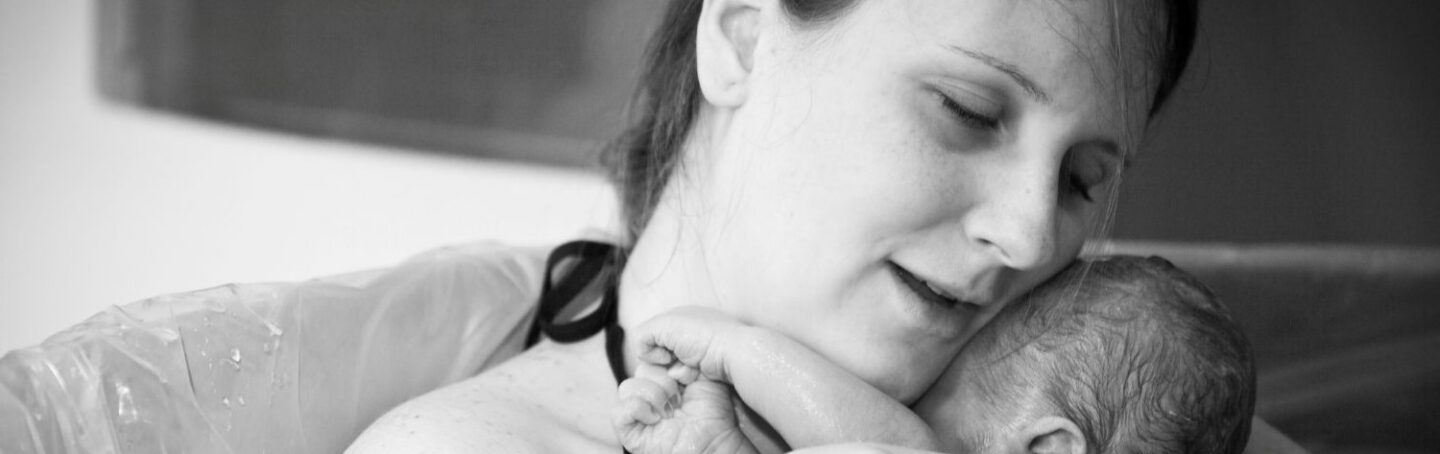


Nurse practitioner Heather Swanson has been a practicing midwife for decades. But when she moved to Nebraska, she was confronted with a piece of state legislation that threatened to upend her career.
The Nebraska Certified Nurse Midwifery Practice Act prevents Certified Nurse Midwives (CNM) from practicing outside a medical facility and attending home births without a “practice agreement” between the midwife and a physician. Failing to comply with the regulation is a felony. Notably, other birth workers, such as lay midwives and doulas, aren’t under the same restriction—only CNMs are barred from attending births outside a hospital.
Swanson found that her ability to accept clients who wanted to give birth at home was undermined. So in 2024, she decided to sue the state attorney general and the state director of the division of public health. A court later ruled that Swanson couldn’t represent her patients through her lawsuit.
Kate Ternus, Amanda Musilek, and Emily Tvrdy, all mothers, subsequently filed a suit of their own, with two arguing that their religious liberties were violated by Nebraska’s regulation, which they said had forced them to give birth in circumstances contrary to their convictions about labor and childbirth.
Though home birth is legal in every state and practiced throughout the country, regulations governing who can attend those births vary widely. Nebraska is the only state to impose a policy this harsh on CNMs.
A policy this severe is especially alarming in a state dominated by maternity deserts, where pre and postnatal care is either hard to access or absent altogether. In fact, 15% of Nebraska’s 2 million citizens reside in rural areas where medical care is hard to come by.
Attorney Joshua Polk of Pacific Legal Foundation is representing the plaintiffs in their case. Polk has no skepticism about what a case of this magnitude could mean for CNMs in Nebraska, or the lack of basic logic underpinning the system currently in place.
“I don’t think there’s any reasonable explanation [for] the restriction that we’re challenging,” Polk told IW Features.
The point, he argued, seems to be to push both patients and midwives into hospitals, burdening midwives financially in the process. Under the regulation, although both parties—the physician and the midwife—must agree to the “practice agreement” they will collaborate under, the physicians hold all of the cards.
“A lot of these are extremely one-sided agreements that extract enormous sums, over $10,000 in some cases, for extremely minimal supervision,” Polk said. “If the physician isn’t willing to enter into an agreement, the CNM can’t practice anywhere, much less provide services at a home birth.”
Though the agreement is legally binding, there is no requirement that a physician guides a CNM’s practice or directly supervises them.
Advocates and midwives already know the potential consequences of imposing these kinds of limitations on mothers. The 2025 March of Dimes reported that infant mortality has increased over the last decade in Nebraska. When both providers and mothers are unnecessarily restrained as to their options, both mother and baby’s health are at a higher risk. Limiting a mother’s options on where or with whom she can birth, as seen in other states, has the potential to motivate some towards practices like unassisted birth, also known as freebirthing.
Polk recognizes both the danger and absurdity in this, especially when some CNMs in the state are forced to turn down religious minorities, such as Amish women, who won’t go to a hospital.
“The contradiction in the policy is that freebirth is entirely legal. There is no restriction whatsoever on having a completely unattended home birth,” he said. “You simply cannot hire any midwife to attend your birth. It makes no sense to allow a riskier option while shutting down a safer option.”
Though midwives and mothers face an uphill battle, the plaintiffs and their representation are optimistic about their case. And they recognize that a victory wouldn’t just impact certified nurse midwives in Nebraska—it would also indicate that the tide is turning for birth workers in maternity deserts all over the country.